Asphalt paving company also offering concrete work, excavating, and snow removal services.
Contact Info
-
130 Co Rd 70
Stillwater, NY 12170 - Call: 518-935-3068
- Text: 518-935-3068
- Mon - Sun: 7am - 7pm
Contact Info
Modern commercial paving does more than fix cracks. It protects your property value, keeps customers safe, and ensures your business stays compliant in 2026.

Modern commercial paving isn’t about slapping down asphalt and calling it done. It’s about understanding that your parking lot affects every part of your business—from the customers who pull in for the first time to the property value you’re building for the long term.
A modern paving company brings more than equipment. We bring an understanding of ADA compliance requirements that changed in 2026, drainage solutions that handle Upstate New York’s freeze-thaw cycles, and sustainable asphalt options that make sense for your budget and the environment. We know that your business can’t shut down for two weeks while we work, so we plan around your operations.
What separates modern paving from the old approach is simple: it’s built to last, designed to comply, and executed with your business in mind. That means proper base preparation, quality materials that can handle commercial traffic, and striping that meets current accessibility standards—not just what passed inspection five years ago.
You might think curb appeal is something residential real estate agents worry about. You’d be wrong. Studies show that 95% of customers say a business’s exterior appearance influences where they choose to shop. That parking lot you’ve been meaning to fix? It’s costing you money every single day.
When someone pulls into your property and sees a smooth, well-maintained parking lot with crisp lines and no potholes, they make an instant judgment about your business. They assume you pay attention to details. They feel confident that if you maintain your exterior this well, you probably run a tight ship inside too. That’s business curb appeal working in your favor.
On the flip side, a deteriorating parking lot sends a different message entirely. Faded striping suggests neglect. Cracks and potholes make people wonder if you’re struggling financially. Uneven surfaces make them worry about tripping or damaging their vehicle. None of these concerns help you close sales or keep tenants happy.
The data backs this up. Research shows that 70% of first-time sales are influenced by curb appeal. That’s not a small number. If you’re in retail, hospitality, healthcare, or any customer-facing business, your parking lot is doing marketing work whether you realize it or not. A modern paving company understands this and approaches parking lot resurfacing as a business investment, not just a maintenance task.
Here’s something else worth knowing: parking lot condition directly affects property value. Commercial real estate professionals report that restriping and resealing a parking lot can raise market value. If you’re planning to sell, refinance, or attract higher-quality tenants, a professionally paved parking lot isn’t optional—it’s essential. Fresh asphalt with clear markings tells potential buyers and tenants that the property has been cared for, which translates directly into higher offers and better lease terms.
ADA compliance isn’t new, but enforcement in 2026 has gotten significantly stricter—especially around parking lots. If your property hasn’t been updated in the last few years, there’s a good chance you’re not fully compliant, and that’s a problem that can cost you tens of thousands of dollars.
Let’s start with what’s actually required. The Americans with Disabilities Act mandates specific numbers of accessible parking spaces based on your total lot size. For lots with 1 to 25 spaces, you need at least one designated accessible spot. The requirements scale up from there, and at least one in every six accessible spaces must be van-accessible. But it’s not just about the number of spaces—it’s about the details.
Accessible parking spaces must be level, with slopes no greater than 2% in any direction. That’s a common compliance issue in older parking lots, especially in areas like Saratoga County and Warren County where freeze-thaw cycles cause settling and uneven surfaces. Your lot might have the right number of spaces painted, but if the slope exceeds 2%, you’re not compliant.
Access aisles are another critical element. These must be clearly marked, at least 60 inches wide, and connect to an accessible route leading to your building entrance. The route itself can’t have curbs, stairs, or obstacles, and it must be at least 3 feet wide with a firm, slip-resistant surface. Signage matters too—accessible spaces must be marked with the International Symbol of Accessibility on signs mounted at least 60 inches above the ground.
Here’s where it gets expensive: fines for ADA violations start at $75,000 for a first offense. Legal settlements, even for small lots, typically range from $15,000 to $50,000. And those numbers don’t include attorney fees or the reputational damage that comes with being sued for discrimination. In Florida, California, and other states with active enforcement, businesses report that “testers” specifically look for non-compliant parking lots to file lawsuits.
A modern paving company doesn’t just fix your asphalt—we assess your lot for ADA compliance and build solutions that meet current standards. That includes proper grading to achieve the required slopes, correctly sized spaces and access aisles, compliant striping and signage, and accessible routes that actually work. This isn’t something you want to guess at or try to handle with a contractor who’s only focused on laying asphalt. Compliance requires knowledge of the specific regulations and experience implementing them correctly.
If your parking lot was installed or last updated more than five years ago, it’s worth having a professional assessment. The cost of bringing your lot into compliance is a fraction of what you’ll pay in fines, legal fees, and lost business if you wait until someone files a complaint.
Want live answers?
Connect with a Morgan Construction expert for fast, friendly support.
Not every damaged parking lot needs to be torn out and rebuilt. In fact, most don’t. Understanding the difference between parking lot resurfacing and full replacement can save you thousands of dollars and weeks of downtime—but only if you make the right call.
Resurfacing involves adding a new 1.5 to 3-inch layer of asphalt over your existing pavement. It costs between $1 and $3 per square foot and typically takes 1 to 3 days to complete. Replacement, on the other hand, means removing everything down to the subgrade and rebuilding from scratch. That runs $4 to $10 per square foot and requires 1 to 2 weeks.
The key question is this: how’s your foundation? If the base layer is still structurally sound and your damage is primarily surface-level—cracks, fading, minor potholes—resurfacing makes sense. But if you’re dealing with base failure, major drainage problems, or a parking lot that’s already been resurfaced once before, replacement is probably your only real option.
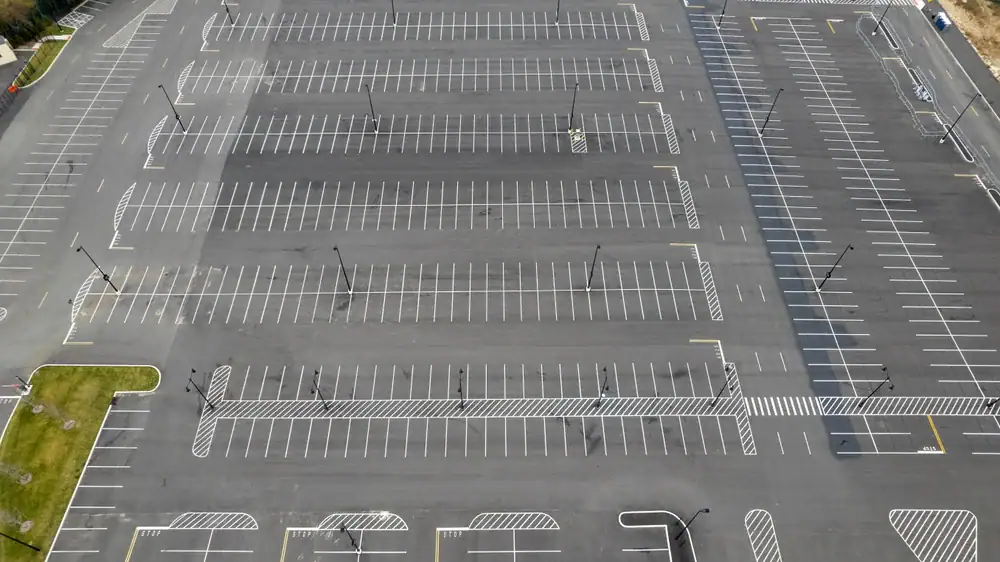
Timing is everything with parking lot resurfacing. Do it too early and you’re wasting money. Wait too long and you’ll end up paying for a complete replacement that could have been avoided. Most commercial parking lots benefit from resurfacing every 12 to 20 years, depending on traffic volume, maintenance history, and climate conditions.
Saratoga County and Warren County present specific challenges that affect this timeline. The freeze-thaw cycles common in Upstate New York accelerate surface deterioration. Water seeps into small cracks, freezes, expands, and makes those cracks bigger. Over time, this process breaks down the top layer of asphalt while the base remains intact. That’s the perfect scenario for resurfacing.
Signs that your lot is ready for resurfacing include widespread surface cracking covering 15% to 30% of the pavement, faded or worn striping that no longer provides clear guidance, rough or uneven surfaces that cause vehicles to bounce, and visible wear patterns in high-traffic areas. If you’re seeing these issues but your parking lot doesn’t have major structural problems like sinking sections or standing water that won’t drain, resurfacing is likely your best option.
Properly executed resurfacing typically adds 8 to 15 years to your parking lot’s functional lifespan. That’s a significant return on investment, especially when you consider that the alternative—full replacement—costs three to five times more. But here’s the catch: that 8 to 15-year range depends heavily on the quality of the work and how well you maintain the surface afterward.
We approach resurfacing as a complete process, not just a quick fix. We’ll assess your drainage to make sure water isn’t pooling anywhere. We’ll repair any base issues before adding the new layer. We’ll use quality asphalt mix appropriate for commercial traffic. And we’ll provide guidance on maintenance—like sealcoating every 2 to 3 years—that protects your investment and extends the life of your pavement even further.
One often-overlooked benefit of resurfacing is the opportunity to update your lot layout and striping to meet current ADA requirements. If your original parking lot was installed before recent compliance updates, resurfacing gives you a chance to reconfigure spaces, improve access aisles, and add proper signage—all while giving your property a fresh, professional appearance.
Sustainability isn’t just a buzzword—it’s becoming a practical consideration for commercial property owners who want to reduce costs, meet environmental goals, and appeal to tenants and customers who care about these issues. The good news is that modern asphalt paving offers some of the most sustainable options available in construction.
Asphalt is 100% recyclable. In fact, about 90 million tons of asphalt pavement are recycled annually in the United States—nearly double the combined total of recycled paper, glass, aluminum, and plastics. When your parking lot is resurfaced or replaced, that old asphalt doesn’t go to a landfill. It’s reclaimed, crushed, and reused in new asphalt mixtures. This process is called reclaimed asphalt pavement (RAP), and it’s standard practice with reputable paving companies.
Using RAP reduces the need for virgin materials, which lowers energy consumption and greenhouse gas emissions associated with asphalt production. It also reduces transportation costs since local materials can be reused on-site or nearby. For commercial property owners, this translates into cost savings and the ability to truthfully claim environmental responsibility in your operations.
Warm-mix asphalt is another sustainable option gaining traction in commercial paving. Unlike traditional hot-mix asphalt, which requires extremely high temperatures, warm-mix is workable at temperatures 20 to 40 degrees lower. This reduces fuel consumption during production, creates a more comfortable working environment for paving crews, and allows for longer haul distances without the material cooling too much. It can also be laid in cooler weather, extending the paving season in areas like Upstate New York where temperature windows are limited.
Porous asphalt is worth considering for certain applications. This type of pavement allows water to pass through the surface and infiltrate the ground below, reducing stormwater runoff and promoting natural groundwater replenishment. The Environmental Protection Agency recognizes porous asphalt as a best management practice for stormwater management. For commercial properties dealing with drainage issues or stormwater management requirements, porous asphalt can eliminate the need for expensive retention systems while providing environmental benefits.
One thing to understand about sustainable asphalt solutions: they’re not more expensive or lower quality than traditional options. In many cases, they’re more cost-effective because they use recycled materials and require less energy to produce. We have experience with these methods and can help you evaluate which sustainable options make sense for your specific property and budget.
If your business has sustainability goals, green building certifications, or corporate responsibility initiatives, incorporating sustainable asphalt solutions into your parking lot project is a tangible way to demonstrate commitment. It’s also something worth mentioning to tenants, customers, and stakeholders who increasingly expect businesses to consider environmental impact in their operations.
Your parking lot is too important to trust to just anyone with a paver and a truck. The right commercial paving partner understands that your property’s exterior directly impacts your business operations, customer perceptions, and long-term value. We approach projects with transparency, experience, and a commitment to getting it done right the first time.
What you’re really looking for is straightforward: someone with proven experience in commercial work, direct communication without the runaround, honest pricing that reflects the actual scope of work, and the ability to handle everything from ADA compliance to drainage solutions. You want a contractor who’s been serving your local area long enough to understand how Upstate New York weather affects pavement and who’s still going to be around if you need them down the road.
Morgan Construction brings over 25 years of hands-on experience to commercial paving projects throughout Saratoga County and Warren County. When you need a parking lot that actually supports your business—not just one that looks okay for a season—reach out and have a real conversation about what your property needs.
Summary:
Article details:
Share: