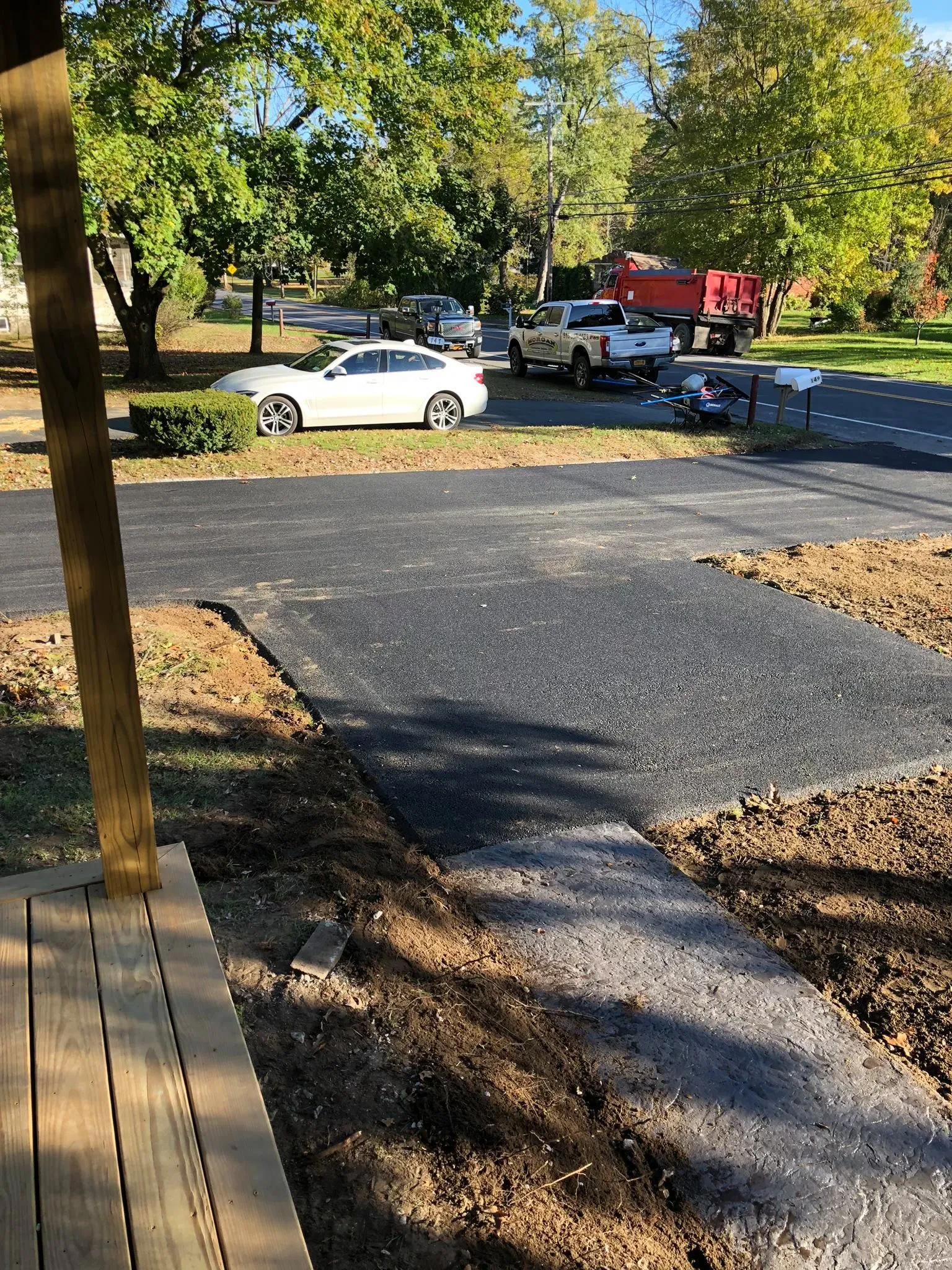
Your driveway’s cracking. Maybe there’s a pothole you’ve been dodging for months, or water’s pooling near the garage after every rain. You know it needs work—but what’s it actually going to cost?
If you’re in Albany County, NY, you’re dealing with more than just normal wear. The freeze-thaw cycle here doesn’t mess around. What starts as a hairline crack in October can turn into a structural problem by April.
This guide breaks down what you’ll pay to repave your driveway in 2026, what drives those costs, and when resurfacing or patching makes more sense. No fluff. Just the numbers and factors that matter.
Estimate Asphalt Driveway Cost: What You’ll Actually Pay
Let’s start with the number you’re here for. In Albany County, NY, repaving an asphalt driveway typically runs between $3,500 and $8,000 for a full installation. That’s for an average two-car driveway, roughly 400 to 600 square feet.
The per-square-foot cost usually falls between $4 and $7, depending on your site conditions, the thickness of asphalt you need, and whether your base requires work. If you’re just getting an overlay on a solid foundation, you might see prices closer to $1 to $3 per square foot.
Here’s the thing—those ranges are wide for a reason. Your driveway isn’t the same as your neighbor’s. Slope, drainage, access, and the condition of what’s already there all shift the final number.
What Drives Your Repave Driveway Cost Higher or Lower
Size is the obvious one. A 200-square-foot single-car driveway costs less than a 600-square-foot double. But size alone doesn’t tell the whole story.
Thickness matters more than most people realize. Standard residential driveways need 2 to 3 inches of asphalt. If you’re parking heavy vehicles or dealing with poor soil conditions, you might need 4 inches. That extra inch adds material cost and labor time.
Your existing driveway’s condition is a big variable. If the base is solid and you’re just dealing with surface cracks, an overlay works. If the foundation’s failing—heaving, sinking, or washing out—you’re looking at full removal and replacement. Demolition adds $1,000 to $3,000 to your project, depending on how much material needs hauling away.
Drainage is non-negotiable in Albany County. Water sitting on your driveway or pooling near the foundation accelerates damage. If your slope’s wrong or you need a drainage system installed, that’s another $400 to $2,400. It’s not optional if you want the new pavement to last.
Access and site prep can surprise you. If crews can’t easily get equipment to your driveway—narrow gates, low-hanging trees, tight turns—labor time goes up. Excavation and grading for a proper base typically add $1,000 to $2,500, especially if your soil’s unstable or you’re dealing with clay.
Permits in Albany County usually run $250 to $2,000, depending on your municipality and project scope. Some towns require them for driveway work; others don’t. We know the local requirements and can guide you through what’s needed.
Curves, slopes, and custom shapes increase labor. A straight, flat driveway is faster to pave than one with elevation changes or decorative edges. Expect 15% to 30% higher costs for complex layouts.
Seasonal timing affects availability and pricing. Late spring through early fall is peak season. Asphalt needs temperatures consistently above 50°F to cure properly. If you’re flexible and can schedule in late fall or early spring, you might catch a slower period and save a bit on labor.
Breaking Down Materials, Labor, and Hidden Costs
Materials typically account for 30% to 50% of your total cost. Hot mix asphalt is the most common choice for residential driveways in Albany County. It’s durable, handles freeze-thaw cycles well, and lasts 15 to 30 years with proper maintenance. Recycled asphalt costs a bit less—around $4 to $9 per square foot—but may require more frequent upkeep.
Labor is the other half. Professional installation runs $5 to $7 per square foot. That includes site prep, base compaction, asphalt application, and finishing. For a 600-square-foot driveway, you’re looking at $3,000 to $4,200 just for labor. That number climbs if your project needs significant grading, old driveway removal, or drainage work.
Demolition is a line item people forget. Removing old asphalt costs $1 to $2 per square foot. Concrete removal is pricier—$2 to $6 per square foot. If your existing driveway’s in rough shape, you’ll also pay for disposal. The good news? Asphalt is 100% recyclable, so we can reduce disposal fees by hauling it to a recycling plant.
Landscaping repairs add up if your driveway work disrupts grass, garden beds, or edging. Expect $4 to $10 per square foot for turf or landscaping that needs fixing after paving.
Add-ons like sealcoating, edging, or heated systems are optional but worth considering. Sealcoating costs around $500 and should be done every 2 to 3 years to protect your investment. Heated driveways—great for Albany winters—run $12 to $21 per square foot but eliminate snow and ice buildup.
The hidden costs? Usually drainage fixes, unexpected base repairs, or permit fees you didn’t budget for. We assess your site upfront and flag potential issues before you’re locked into a price.
Driveway Resurfacing Cost: When Overlay Beats Replacement
Resurfacing—also called an overlay—is the budget-friendly middle ground. Instead of tearing everything out, you’re adding a new 1.5 to 2-inch layer of asphalt over the existing surface. In Albany County, resurfacing typically runs $1,500 to $4,500 for a standard driveway.
It’s a smart move if your foundation’s still solid but the surface is showing age. Think minor cracks, fading, or surface wear—not potholes, heaving, or drainage problems. Resurfacing extends your driveway’s life by 8 to 15 years and costs significantly less than full replacement.
The key question: is your base still good? If less than 25% to 30% of your driveway needs repairs and it’s under 15 to 20 years old, resurfacing probably makes sense. If you’re seeing alligator cracking, standing water, or sections sinking, the foundation’s compromised and you’ll need a full repave.
Resurfacing a Driveway Cost vs. Full Repave: Making the Call
Resurfacing costs $1 to $3 per square foot—about half what you’d pay for full replacement. For a 400-square-foot driveway, that’s $400 to $1,200 compared to $2,800 to $5,600 for repaving.
But resurfacing only works if the underlying structure is sound. Water damage, base erosion, or widespread cracking means the problem’s deeper than the surface. Slapping new asphalt over a failing foundation just delays the inevitable—and you’ll be back to square one in a few years.
Here’s how to tell: walk your driveway and look for patterns. Hairline cracks that aren’t spreading? Resurfacing can handle that. Potholes, sunken areas, or cracks wider than a quarter-inch? Those signal base issues. Standing water or poor drainage? That’s a foundation problem that resurfacing won’t fix.
In Albany County’s climate, drainage is critical. If water’s getting under your asphalt and freezing, it’s expanding and breaking apart the base. A fresh overlay won’t stop that cycle. You need proper grading and possibly a drainage system—which means full repaving.
Resurfacing also doesn’t let you change your driveway’s layout, slope, or width. If you want to widen for a second car or fix a drainage angle, you’ll need to repave. Think of resurfacing as a facelift. Repaving is a rebuild.
Cost-wise, resurfacing saves money upfront but has a shorter lifespan—8 to 15 years versus 15 to 30 for a full repave. If your driveway’s nearing the end of its useful life anyway, spending on resurfacing might just be kicking the can down the road. Sometimes paying more now for a full repave saves you from doing the job twice.
You want an honest assessment. If someone’s pushing resurfacing on a driveway that clearly needs replacement, that’s a red flag. Same goes for insisting on full repaving when your base is fine. We’ll tell you what your driveway actually needs, not what makes us the most money.
Driveway Refinishing Cost: Repairs and Maintenance Options
Refinishing usually refers to smaller-scale repairs—crack sealing, patching, or sealcoating. These are the maintenance moves that extend your driveway’s life between major projects. In Albany County, crack sealing and minor patching typically cost $300 to $2,500, depending on how much damage you’re addressing.
Crack sealing is straightforward. We use hot rubberized sealant to fill cracks and prevent water infiltration. It’s cheap—often a few hundred dollars—and buys you time before you need resurfacing or repaving. In upstate New York, it’s worth doing every few years just to keep freeze-thaw damage from accelerating.
Patching handles potholes and localized failures. Asphalt patches cost $2 to $5 per square foot. If you’ve got one or two trouble spots but the rest of your driveway’s solid, patching makes sense. It’s a temporary fix, though. Patched areas don’t bond perfectly with old asphalt, so water can still seep in and cause problems down the line.
Sealcoating is preventative. It costs around $500 for an average driveway and should be done every 2 to 3 years. Sealcoating locks out water, UV rays, and road salt—the three things that destroy asphalt fastest in the Capital Region. It’s not a repair; it’s insurance. If you’re not sealcoating regularly, you’re shortening your driveway’s lifespan.
Here’s the reality: repairs and refinishing work when your driveway’s fundamentally sound. If you’re patching the same spots every year or sealing cracks that keep coming back, the base is probably failing. At that point, you’re throwing money at a losing battle. We’ll tell you when it’s time to stop repairing and start repaving.
The decision comes down to math. If your repair costs are hitting 40% to 50% of what a full repave would cost, just repave. You’ll get a fresh start, better drainage, and 15 to 30 years of life instead of limping along with Band-Aid fixes.
What to Expect When You’re Ready to Repave
You’ve got the numbers. You know what drives costs up or down. You understand when resurfacing makes sense and when it’s time for a full repave.
The next step is getting an honest assessment of what your driveway actually needs. Not a sales pitch—a real evaluation from someone who knows Albany County’s climate, understands freeze-thaw damage, and won’t upsell you on work you don’t need.
We’ll walk your property, explain what we’re seeing, and give you options. We’ve been doing this locally for over 25 years and have a reputation to protect. When you’re spending $3,500 to $8,000 or more, you deserve transparency, quality work, and a driveway that’ll last.